One-off, from any country
Donate with PayPal
With your PayPal account or a card. You choose the amount.
The PayPal button only loads when you press it. Not working? Open PayPal in a new tab.
Esta página también está en español.
Leer en españolPlanetarium and space navigator · free and source-available
See the sky from your exact spot, with your mountains, your clouds and your time. And find out how far everything is, how long it would take to get there and when to leave.
No account · no ads · in English and Spanish · in the browser or installed as an app
What it is
Teseo is a planetarium, an interplanetary navigator, a sky calendar and a lab, all at once. It doesn’t just tell you what’s up there: it works out distances, routes and departure dates with real physics and official data.
It was born in Cayambe, at latitude zero, out of a need at Killa Ñan: to tell and share astronomy better from a single tool. This page follows its thread: from where you stand to the end of the universe.
1 · The thread starts at your feet
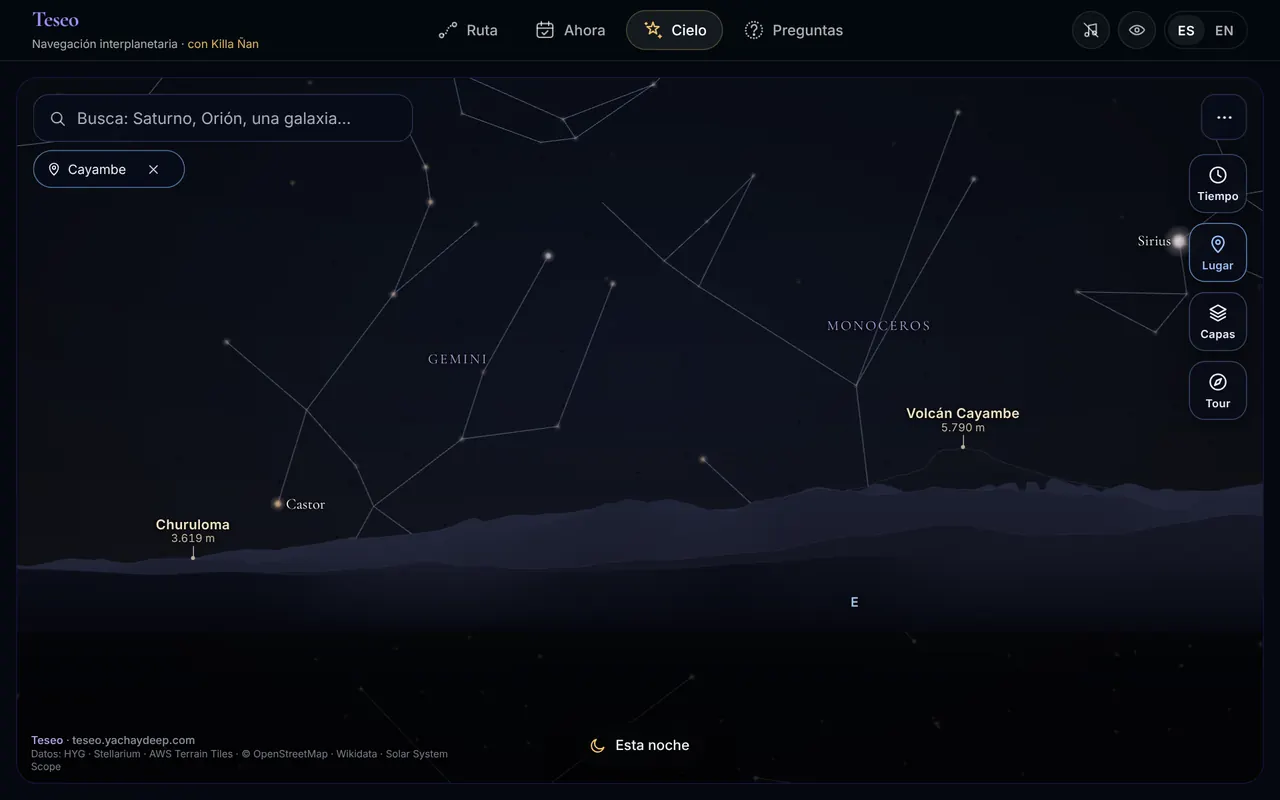
Most planetariums draw a flat horizon, the same for Quito as for Madrid. Teseo computes yours.
2 · Follow the thread across the Solar System
From your sky, the thread runs on to the planets: Teseo works out journeys with real orbital physics and tells you what is happening up there today.
The ship does not fly in a straight line: it covers half an ellipse around the Sun, and Mars has to be at the arrival point just as the ship gets there. That coincidence comes round every 26 months.
Orbits to scale (1 AU and 1.524 AU), with the real periods of 365.25 and 686.98 days. Simplified model: circular orbits in a single plane. With the real orbits the window shifts a little each time; Teseo works it out from NASA JPL Horizons positions. While you wait, time runs faster than during the trip.
3 · All the way to the big questions
In Questions you don’t read about the universe: you experiment with it. Change a number and watch what happens, using the figures published by the science teams.
Nobody has brought back a piece of a star. But its light, passed through a prism, arrives with dark lines: each element always leaves the same ones, like a barcode.
Each element always absorbs the same colours. The lines are at their laboratory wavelengths, in nanometres (the calcium lines are those of ionised calcium); their thickness here is illustrative, and only some of each element’s lines are shown. In a real star they do not all appear with the same strength: it depends on its temperature. The inset enlarges the sodium doublet.
More tours to follow the thread in Questions:
4 · How Teseo knows it is true
Everything Teseo shows comes from public data by space agencies, observatories and volunteer communities. Here they are, so you can check them, use them or join in.
Ephemerides checked against NASA and the US Naval Observatory.
AI only describes what physics has already worked out.
No account, no sign-up: your location is only used to work out your sky.
Anyone can review, use and improve it for non-commercial purposes (PolyForm Noncommercial 1.0.0 licence).
Tap a number on the image to see where what it shows comes from.
 1
2
3
4
5
6
7
The full list, with the licence and use of each dataset, is in CREDITS.md. Spotted a figure that doesn't add up? Tell us by WhatsApp or by email.
5 · We weave the thread together
Teseo was born out of a need at Killa Ñan, the community astronomy initiative working in Cayambe since 2018: to tell and share astronomy better from a single tool. Today amateurs, teachers and curious people use it.
Podcast · 15 min · in Spanish
A conversation about where Teseo comes from, how it knows what it says is true, Andean astronomy and what comes next.
Audio generated with Google’s NotebookLM (AI voices) from Teseo’s documentation. You can also listen on NotebookLM.
Looking at the sky helps science too. These projects take observations from anyone, no astronomer needed.
The same thread, on video
The sky map, your horizon, trips across the Solar System and the big questions, filmed in the app itself.
Your real horizon, with the terrain, the curvature of the Earth, the clouds and the monuments.
The Hohmann transfer, the 44° angle and the window that comes back every 26 months.
Four tiny points of light that changed astronomy, and how to see them tonight.
The spectrum of light, its dark lines and how helium was discovered in the Sun.
From a cloud of gas to a white dwarf, a supernova or a black hole: it all depends on mass.
The Drake equation, with numbers you can change yourself.
Expansion, dark energy and the possible endings.
The videos are narrated in Spanish, with synthetic voices.
Teseo is and will stay free, with no ads and without asking you for data. Donations pay for the servers, the domain and the time to keep improving it.
One-off, from any country
With your PayPal account or a card. You choose the amount.
The PayPal button only loads when you press it. Not working? Open PayPal in a new tab.
Monthly
A monthly contribution from your GitHub account, from USD 5, to keep the project going over time. GitHub charges no fees.
Sponsor on GitHubIn Ecuador
Scan the code with DeUna or the Banco Pichincha app, enter the amount and you're done. Rather transfer from another bank? We'll send you the details by WhatsApp.
The account is in the name of Carlos Vásconez-Paredes, who created Teseo.
No money needed
Share a postcard or a 360° photo, or tell us about a bug or an idea. Everything helps.
Report a problemAlso by email. Do you code? See the code.
Teseo tells you what you’ll see, from where and at what time.
Open the sky